
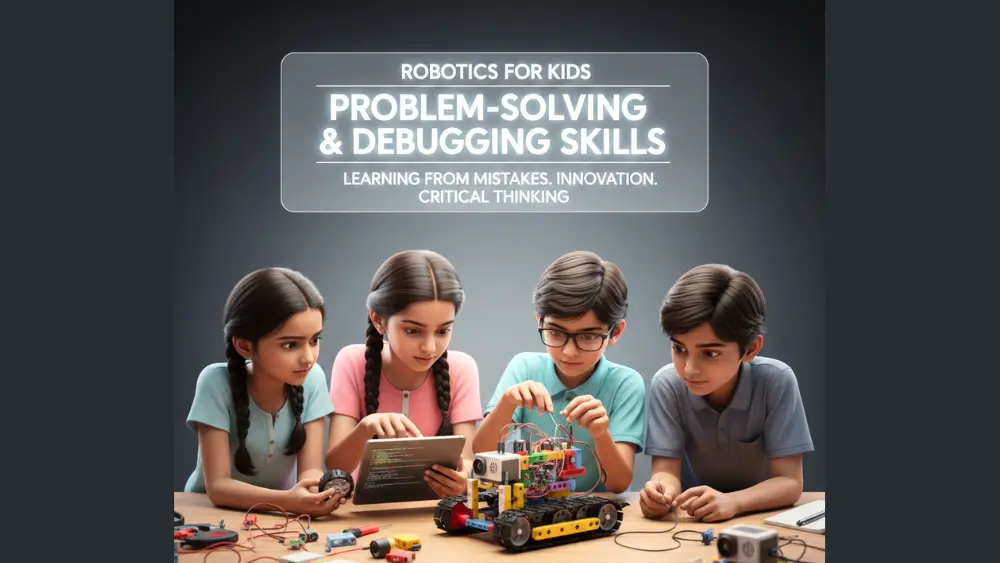
Many parents in India enroll their children in robotics classes thinking it is only about building a small car or assembling a kit. But the real benefits of robotics for kids in India go far beyond just making a robot move.
In fact, I have personally seen many students — even mature ones — attach wheels directly to a motor shaft expecting the car to run smoothly. The wheels rotate perfectly in the air. But the moment they touch the ground, they stop. Why? Because the motor does not produce enough torque to overcome friction. That is when children truly begin to understand the importance of gears, speed reduction, and mechanical advantage.
This is where robotics for kids in India becomes powerful. Instead of learning science and mathematics only from textbooks, children experience real engineering concepts through hands-on robotics learning. They understand how gear systems increase torque, how rotary motion converts into linear motion, how batteries power circuits, and how changing a few lines of code can completely alter a robot’s movement.
Robotics education is not just another extracurricular activity. It is a practical form of STEM robotics learning that builds problem-solving skills, logical thinking, and technical confidence at an early age. When students build, test, fail, and improve their models, they start thinking like engineers rather than just memorizing formulas. If you are new to this topic, you may first understand what STEM robotics education means and how it works for children.
In this comprehensive 2026 parent guide, we explore the complete benefits of robotics for kids in India and why more families are choosing STEM robotics education for long-term academic growth.
Table of Contents
1. Understanding Gears, Torque & Real Engineering Concepts
One of the most important benefits of robotics for kids is that they begin to understand real mechanical engineering concepts like torque, gear ratios, friction, and speed reduction — not just in theory, but through practical experience.
In many robotics classes, children initially believe that attaching wheels directly to a motor shaft will make a car move easily. When the motor runs in the air, the wheels rotate perfectly. However, the moment the wheels touch the ground, they stop. This happens because the motor does not produce enough torque to overcome friction between the wheels and the surface.
This simple experiment teaches a powerful lesson: speed alone is not enough — torque is essential.
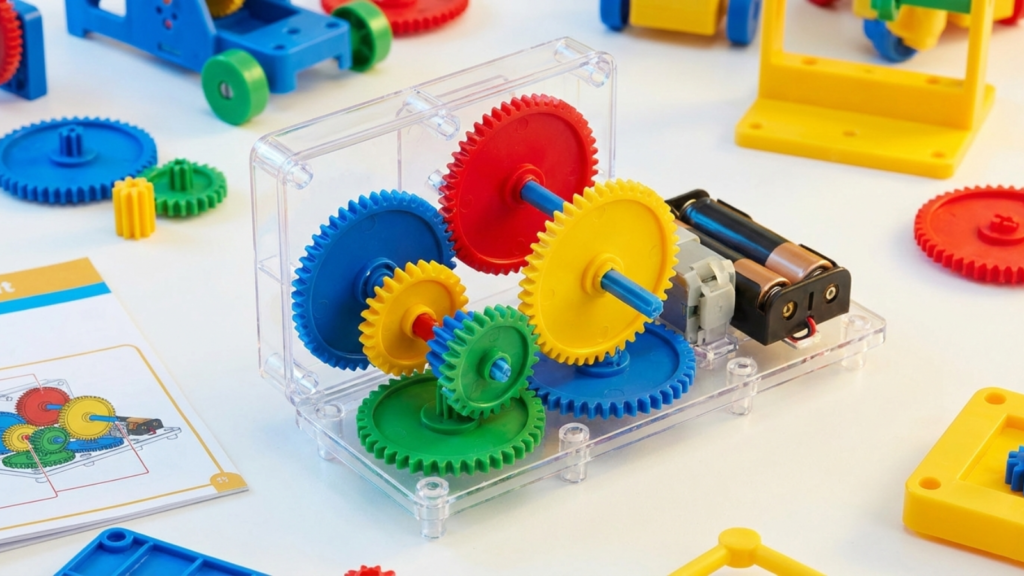
🔧 What Children Learn About Torque
Through hands-on robotics learning, students discover:
- A motor rotates very fast but produces low torque.
- When gears are added, speed reduces but torque increases.
- Gear reduction systems help robots move heavier loads.
- Friction plays a major role in real-world motion.
They understand why a high-speed motor without proper gearing cannot move a robot car effectively. This practical understanding of torque makes physics concepts clear and memorable.
⚙ Understanding Gear Systems in Robotics
Robotics kits often include:
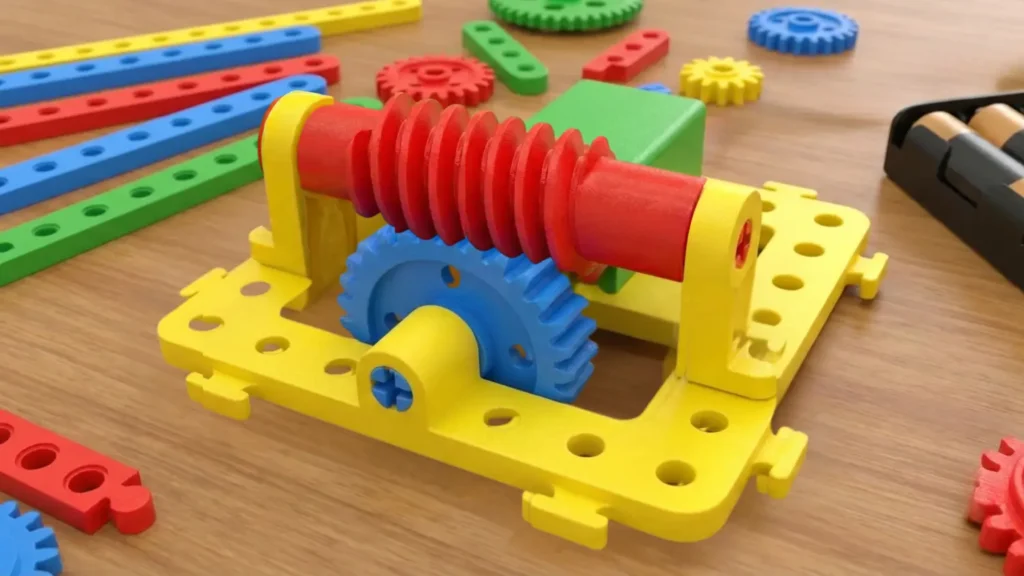
- Worm gears
- Gear trains
- Rack and pinion systems
- Ratchet mechanisms
When students build these mechanisms, they learn how gear ratios work. For example:
- A small gear driving a larger gear increases torque.
- A larger gear driving a smaller gear increases speed.
- Rack and pinion converts rotary motion into linear motion.
- Ratchet systems allow motion in one direction while preventing reverse movement.
Instead of memorising definitions, children physically see and test how mechanical power transmission works.
🚗 From Concept to Real-World Application
This is where robotics education in India becomes truly powerful. Students connect classroom physics topics such as force, friction, rotational motion, and mechanical advantage with real machines.
They start thinking like young engineers:
- Why is the robot not moving?
- Is torque insufficient?
- Do we need additional gear reduction?
- Is friction too high?
This problem-solving approach builds strong STEM robotics learning foundations and develops technical confidence at an early age.
When children understand gears and torque through robotics, they are not just assembling parts — they are learning the fundamentals of mechanical engineering in a practical and engaging way.
2. Learning How Rotary Motion Converts into Linear Motion
Another major benefit of robotics for kids is that they clearly understand how rotary motion converts into linear motion — and vice versa. This is a fundamental concept in physics and mechanical engineering, yet it often remains abstract in textbooks. Through robotics education, children see this principle working directly in front of them.
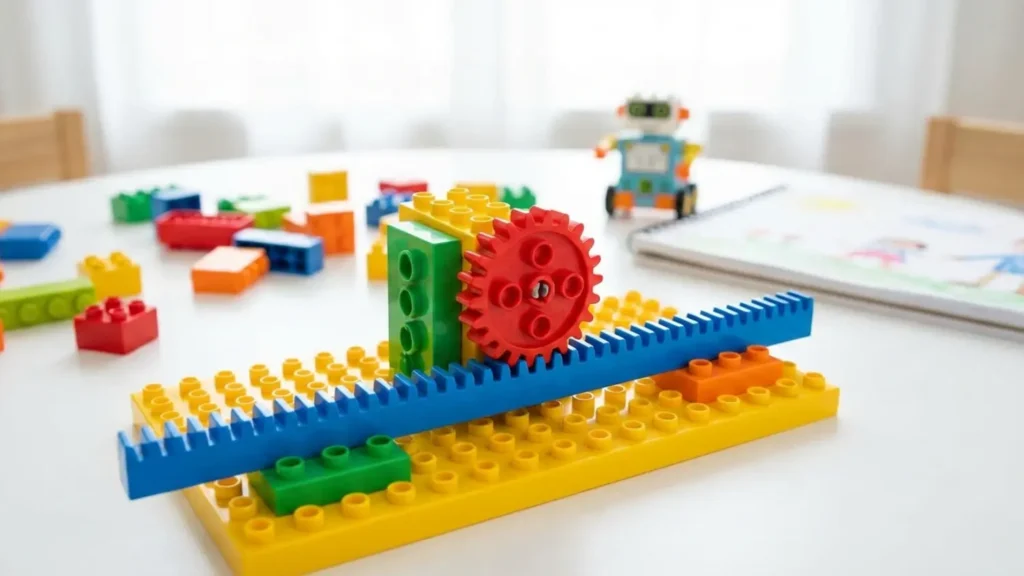
Most motors used in robotics kits produce rotary motion. The motor shaft rotates in a circular movement. However, many robotic applications require straight-line (linear) motion — such as pushing an object, lifting a load, or moving forward in a straight path. Robotics projects help students discover how this transformation happens.
🔄 From Rotation to Straight-Line Movement
When children build different mechanisms, they observe how motion changes form:
- A rack and pinion system converts rotary motion into linear motion.
- A lead screw mechanism moves an object forward or backward when the screw rotates.
- A crank-slider mechanism converts circular motion into back-and-forth movement.
- Wheels convert rotary motion into linear displacement of the robot across the ground.
Instead of memorizing definitions, students assemble these systems and watch how a rotating motor can push, pull, lift, or slide components in a straight line.
This hands-on robotics learning makes mechanical concepts much easier to understand.
⚙ Practical Understanding Through Robotics Kits
In many robotics for kids programs in India, students build:
- Robotic arms
- Automatic doors
- Line-following robots
- Obstacle-avoiding cars
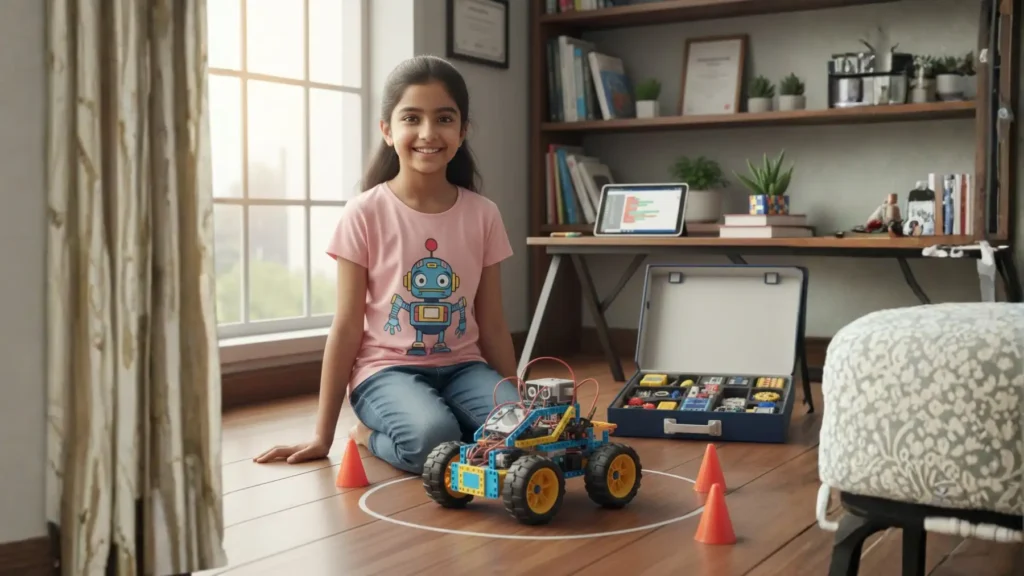
During these projects, they naturally learn:
- How motion is transmitted
- How mechanical linkages work
- How speed and direction affect movement
- How precise control is achieved
They also realise that movement is not just about power — it is about mechanism design.
For example, if a robot must lift an object vertically, students understand that direct motor rotation is not enough. A proper mechanism is required to convert motion effectively and safely.
🧠 Connecting Physics to Real Engineering
Through STEM robotics learning, abstract topics like:
- Rotational motion
- Linear displacement
- Mechanical advantage
- Kinematics
become practical and visual.
This builds deep conceptual clarity. Children begin asking intelligent questions:
- Why is the linear motion not smooth?
- Is the gear alignment correct?
- Is friction affecting the slider?
- Do we need better mechanical support?
This analytical thinking is one of the strongest benefits of robotics education for students.
Instead of learning motion as a formula on paper, they experience it as a real engineering principle. That experience stays with them far longer than textbook theory.
3. Understanding How Batteries and Electrical Circuits Work
One of the most valuable benefits of robotics for kids is that they learn how batteries and electrical circuits actually work in real life. Instead of memorising definitions about current and voltage, children see how electricity powers their robot and understand why a circuit must be complete for a motor to run.
In most robotics kits for kids, the first task is simple: connect a battery, motor, and switch. But even this basic activity teaches powerful engineering principles.
🔋 How Children Understand Battery Power
Through hands-on robotics learning, students discover:
- A battery stores chemical energy and converts it into electrical energy.
- Current flows from the positive terminal to the negative terminal through a complete circuit.
- If any wire is loose, the motor stops.
- A weak battery reduces motor performance.
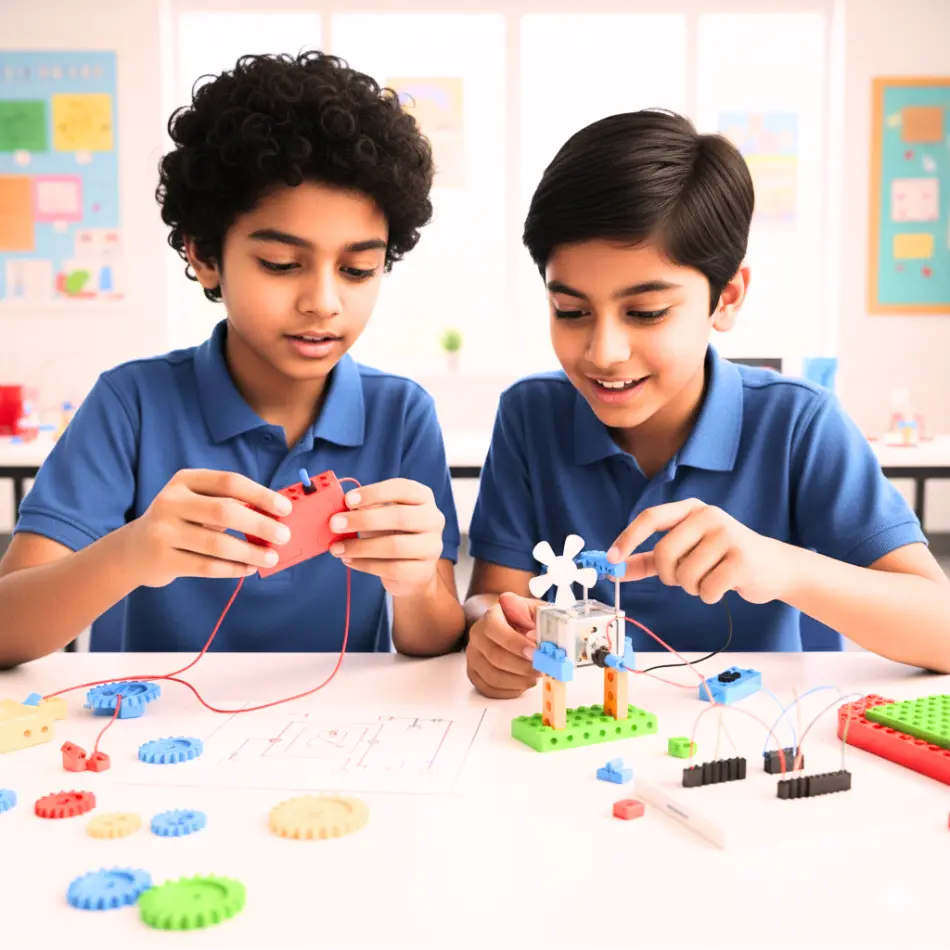
They observe directly that when the circuit is incomplete, nothing works — and when the switch is turned on, the circuit is completed and the robot moves. This makes the concept of “closed circuit” extremely clear.
Instead of abstract theory, robotics education makes electricity visible.
🔌 Series and Parallel Connections in Robotics
When students experiment with multiple batteries or components, they begin to understand:
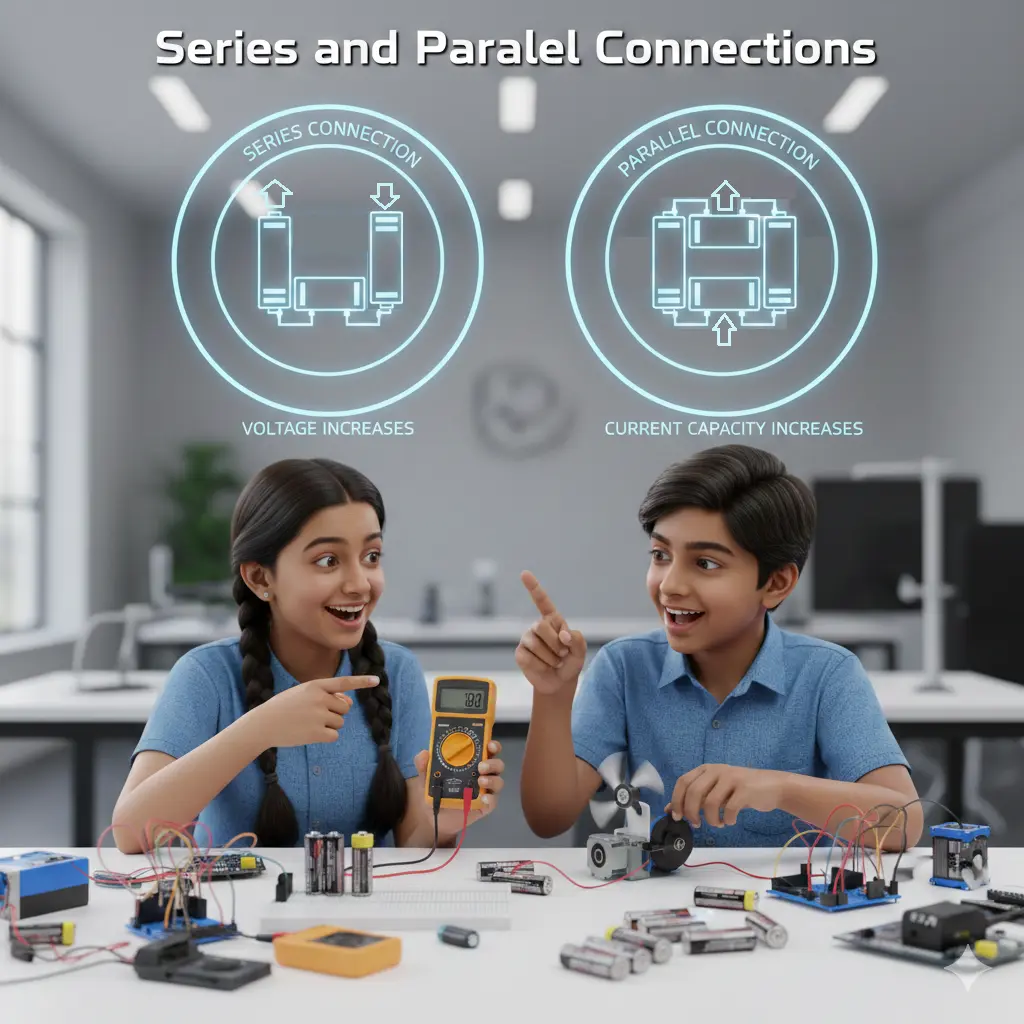
- In a series connection, voltage increases.
- In a parallel connection, current capacity increases.
- Incorrect wiring may reduce efficiency or stop the robot from functioning.
For example, if a motor runs slowly, children learn to check:
- Is the battery properly connected?
- Is the voltage sufficient?
- Are wires correctly placed?
- Is there high resistance in the circuit?
This troubleshooting process builds logical reasoning and analytical thinking.
⚡ Learning Through Real Testing and Debugging
Robotics for kids in India often involves trial and error. When something does not work, students must identify the problem:
- Is the switch faulty?
- Is the polarity reversed?
- Is the connection loose?
- Is the power supply insufficient?
This develops practical electrical knowledge that textbooks alone cannot provide.
🧠 Making STEM Concepts Practical
Through STEM robotics learning, children understand key physics concepts such as:
- Voltage
- Current
- Resistance
- Energy conversion
- Power transmission
They realise that electricity is not invisible magic — it follows clear rules. When they see a robot respond immediately after completing a circuit, the learning becomes exciting and memorable.
This practical exposure to battery systems and circuit design is one of the strongest robotics education benefits, especially for students in India where hands-on science learning is often limited in traditional classrooms.
Instead of passively reading about circuits, children build, connect, test, and improve. That active learning builds deep confidence and prepares them for advanced STEM subjects in the future.
4. Coding Becomes Real — Not Just Theory
Today, many schools in India have introduced coding as part of their curriculum. Students learn basic programming concepts, syntax, loops, and conditional statements. However, one of the most powerful benefits of robotics for kids is that coding becomes practical, visible, and exciting — not just lines of text on a computer screen.
In traditional classrooms, children may write a program and see output only as text or simple animations. In robotics education, even a small change in code immediately changes how the robot behaves. This direct connection between code and physical movement creates deep engagement.
💻 From Screen Code to Physical Movement
When students program a robot, they quickly realise:
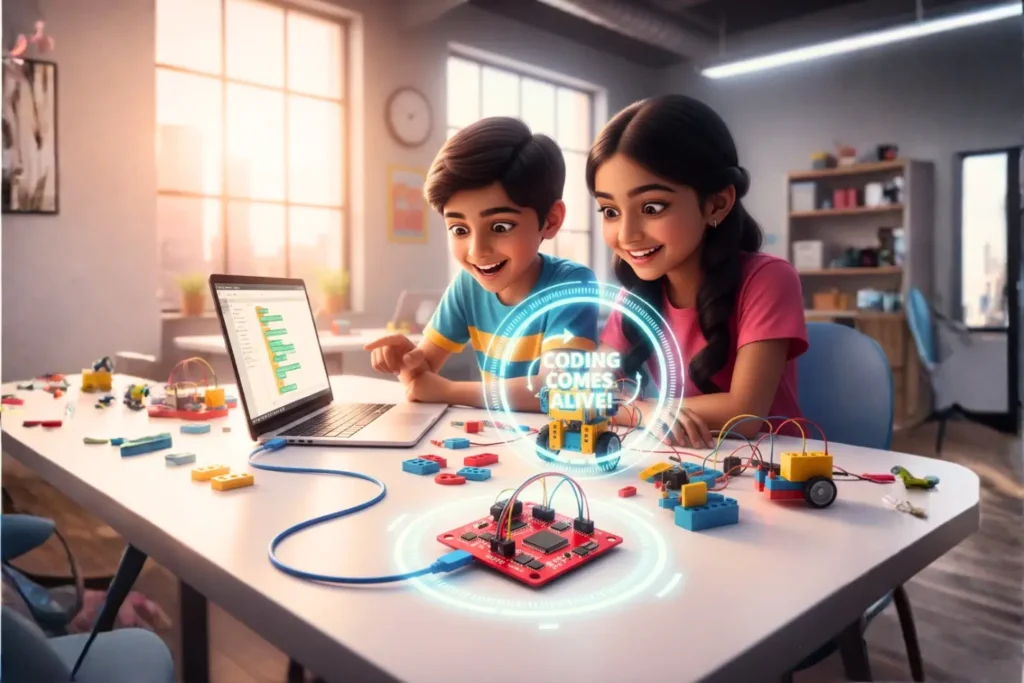
- Changing delay time affects speed.
- Modifying motor values changes direction.
- Adjusting sensor conditions alters robot behavior.
- Updating logic improves task performance.
- For example, if a robot is programmed to move forward for two seconds and then turn right, changing the time value to three seconds makes it travel further before turning. This simple experiment helps children understand how logic controls motion.
Coding is no longer abstract — it controls something real.
🤖 Understanding Logic Through Robotics
Robotics for kids in India often involves programming tasks such as:
- Line-following robots
- Obstacle-avoiding robots
- Remote-controlled cars
- Sensor-based automation projects
Through these projects, children learn:
- How “if-else” conditions work in real life
- How loops repeat actions
- How sensor input affects decision-making
- How debugging improves performance
Instead of memorising programming syntax, they see how logical thinking directly influences machine behaviour.
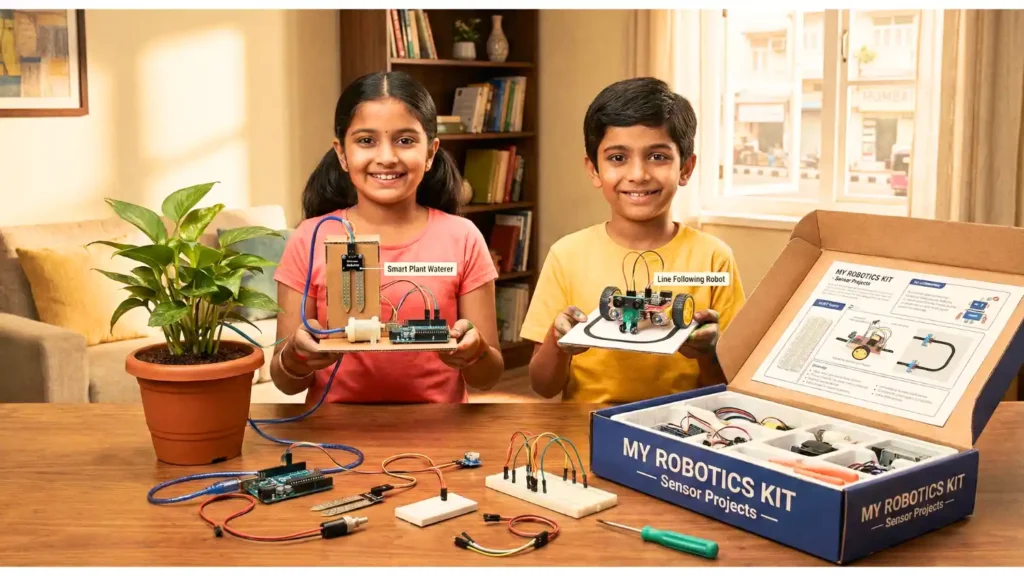
🧠 Developing Computational Thinking
One of the biggest robotics education benefits is the development of computational thinking. Students begin asking questions like:
- Why did the robot stop?
- Is the sensor threshold correct?
- Is the delay too short?
- Is the loop running properly?
They learn to test, observe, modify, and improve. This trial-and-error process builds strong problem-solving skills and analytical ability.
Through STEM robotics learning, children understand that coding is not just about writing commands — it is about controlling systems intelligently.
🚀 Building Confidence Through Creation
When a child modifies code and sees the robot respond exactly as intended, it creates excitement and confidence. They feel a sense of control and achievement that is rarely experienced through textbook learning alone.
This practical coding exposure prepares students for advanced technologies such as:
- Artificial Intelligence
- Automation
- Internet of Things (IoT)
- Embedded systems
By making coding real and interactive, robotics education transforms programming from a classroom subject into a creative engineering skill.
5. Problem-Solving and Debugging Skills Development
One of the most powerful benefits of robotics for kids is that it naturally develops strong problem-solving and debugging skills. Unlike traditional classroom learning, robotics does not always work perfectly on the first attempt. Robots may stop, move incorrectly, or behave unexpectedly. This creates valuable learning opportunities.
In robotics education, mistakes are not failures — they are part of the process.
🔍 Learning to Identify the Root Cause
When a robot does not function properly, students must investigate:
- Is the battery fully charged?
- Are the wires connected correctly?
- Is the motor damaged?
- Is the code written properly?
- Is the sensor aligned accurately?
Instead of waiting for a teacher to give the answer, children begin analysing the problem step by step. This structured troubleshooting process is one of the most important robotics education benefits.
They learn that every technical issue has a logical reason behind it.
🛠 Mechanical and Electrical Debugging
Robotics for kids in India often includes hands-on assembly of gears, motors, and circuits. During this process, students discover:
- A loose gear may reduce torque.
- Misalignment may cause friction.
- Incorrect polarity may stop the motor.
- Weak battery voltage may reduce speed.
These practical debugging experiences build technical awareness. Children understand that machines follow physical laws and that solutions require careful observation.
💻 Debugging in Coding
Coding errors are also common in robotics projects. A small mistake in logic can cause unexpected behaviour. For example:
- A wrong delay value may change movement timing.
- Incorrect sensor threshold may prevent detection.
- Missing loop condition may stop repetition.
Through STEM robotics learning, students learn how to test, modify, and improve their programs. They realise that debugging is not about guessing — it is about systematic thinking.
🧠 Building Analytical Thinking and Patience
Robotics teaches children to:
- Break large problems into smaller parts.
- Test one component at a time.
- Observe carefully before making changes.
- Improve designs gradually.
This develops analytical thinking, patience, and resilience — qualities that are essential for future engineers, scientists, and innovators.
Instead of becoming frustrated when something does not work, children learn to ask:
- What went wrong?
- How can I improve it?
- What should I test next?
This mindset shift is one of the greatest benefits of robotics education for students.
Through continuous experimentation, robotics transforms children into confident problem-solvers who are not afraid of challenges.
6. Understanding Sensors and Automation in Robotics
Another major benefit of robotics for kids is that they learn how sensors and automation systems work in real life. In today’s world, everything from automatic doors to smart home devices depends on sensors. Through robotics education, children understand how machines detect, decide, and respond.
Instead of simply pressing buttons, students build robots that can sense their environment and act accordingly.
👀 What Are Sensors and Why Are They Important?
In robotics kits for kids, common sensors include:
- Infrared (IR) sensors
- Ultrasonic distance sensors
- Light sensors
- Touch sensors
- Line-following sensors
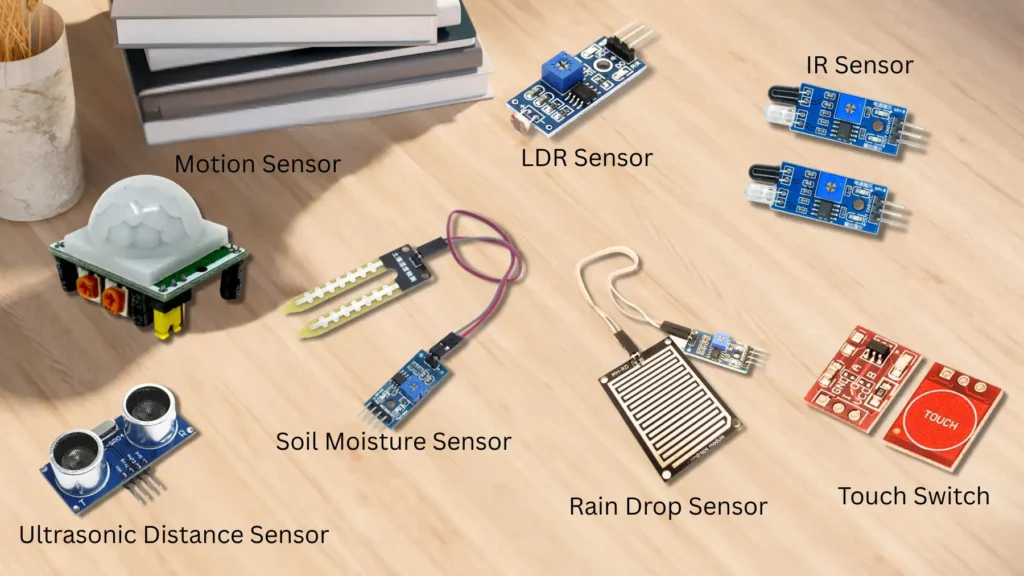
When children connect these sensors to a microcontroller, they see how input signals control movement. For example:
- An ultrasonic sensor detects an obstacle and stops the robot.
- A line sensor helps the robot follow a black path.
- A light sensor turns on LEDs in low light conditions.
This hands-on robotics learning makes automation simple and understandable.
🤖 From Sensor Input to Intelligent Action
Through STEM robotics learning, children realise that a robot does not move randomly. It follows logic:
- Sense the environment
- Process the information
- Take action
For instance, in an obstacle-avoiding robot:
- The sensor measures distance.
- The program checks if the distance is below a set value.
- If yes, the robot changes direction.
This simple process introduces children to the fundamentals of automation and artificial intelligence.
⚙ Real-World Applications of Automation
Robotics for kids in India often includes projects that simulate real-world systems, such as:
- Automatic parking sensors
- Smart traffic light models
- Security alarm systems
- Temperature-controlled devices
When students build these models, they begin to understand how modern machines operate in industries, hospitals, transportation systems, and smart homes.
Instead of memorising definitions of automation, they see how automated decision-making works in practice.
🧠 Developing Logical and Systems Thinking
Working with sensors teaches children to think in systems:
- What input is required?
- What condition must be checked?
- What output should be triggered?
- How fast should the response be?
This strengthens logical reasoning and structured thinking. Children learn that machines follow clear cause-and-effect relationships.
Understanding sensors and automation is one of the strongest robotics education benefits because it prepares students for future technologies such as:
- Artificial Intelligence
- Internet of Things (IoT)
- Smart robotics
- Industrial automation
By exploring sensors and automation through robotics, children gain early exposure to the technologies that are shaping the future.
7. Teamwork and Project-Based Learning Skills
Beyond mechanical and coding skills, one of the important benefits of robotics for kids is the development of teamwork and collaborative learning abilities. Robotics education is rarely an individual activity. Most projects require students to work together, share ideas, and divide responsibilities.
In many robotics classes and STEM programs in India, children build robots in small groups. This project-based approach helps them experience how real engineering teams function.
👥 Learning to Work as a Team
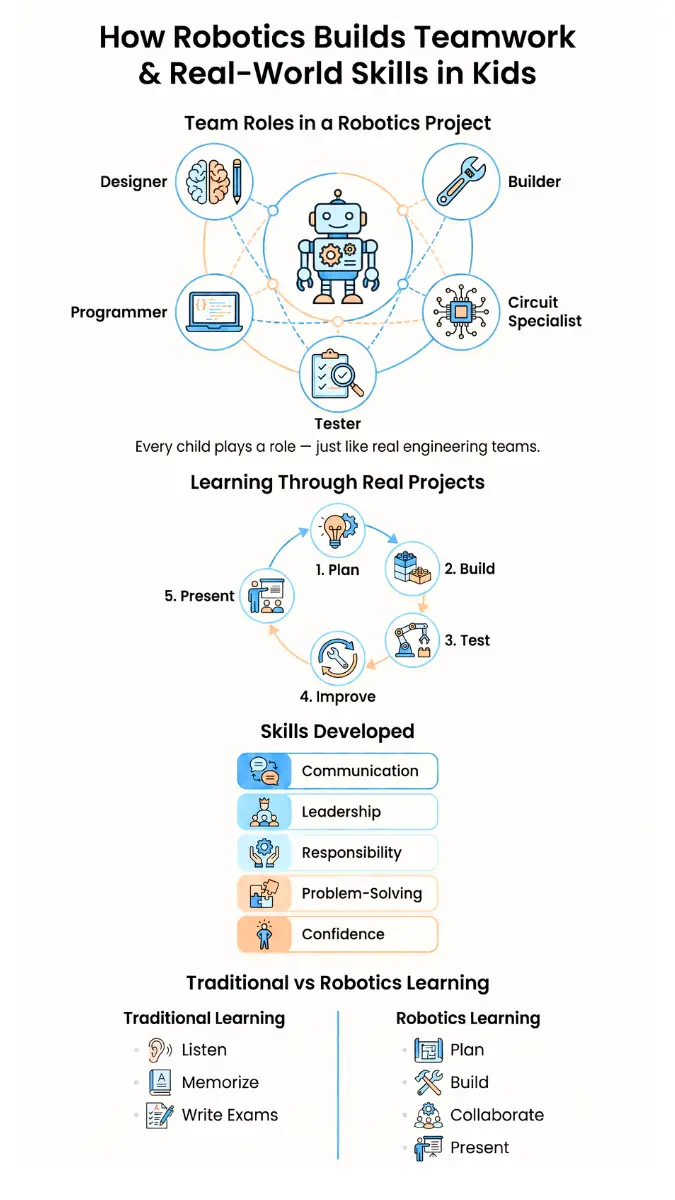
During robotics projects, students often take different roles such as:
- Designing the structure
- Assembling mechanical parts
- Connecting circuits
- Writing the program
- Testing and debugging
This division of tasks teaches children how to communicate clearly, coordinate efforts, and respect others’ ideas. They learn that building a robot successfully requires cooperation, not competition.
Team-based robotics for kids in India encourages leadership, responsibility, and accountability from an early age.
🛠 Project-Based Learning in Action
Unlike traditional classroom teaching, robotics follows a project-based learning model. Students are given a real problem to solve, such as:
- Build a robot that can avoid obstacles
- Design a system that follows a line
- Create an automatic door mechanism
- Develop a sensor-based alarm system
To complete the project, they must plan, test, modify, and improve their designs. This process helps them understand that learning is not about memorising answers — it is about building solutions.
Project-based STEM robotics learning makes education active and engaging.
🧠 Improving Communication and Presentation Skills
When children complete a robotics project, they are often encouraged to explain:
- How the robot works
- What challenges they faced
- How they solved technical issues
- What improvements can be made
This builds confidence in communication and public speaking. Students learn to present technical ideas clearly, which is a crucial skill for future engineers and professionals.
🚀 Preparing for Real-World Engineering Environments
In real industries, engineers work in teams to design machines, software, and automation systems. Through robotics education benefits, children get early exposure to this collaborative working style.
They understand:
- Planning is important before building.
- Testing is essential after designing.
- Feedback helps improve results.
- Success comes through teamwork.
This structured and cooperative approach is one of the strongest long-term benefits of robotics education for students.
By combining teamwork with hands-on robotics learning, children not only build machines — they also build essential life skills that will support them throughout their academic and professional journey.
8. Boosting Confidence and Creativity Through Real Innovation
One of the most visible benefits of robotics for kids is the boost in confidence and creativity that comes from building something that actually works. When a child assembles a robot, connects the circuit, uploads the code, and sees it move successfully, the sense of achievement is powerful.
Robotics education turns ideas into reality. That transformation builds self-belief.
🚀 From “I Can’t” to “I Built This”
Many students initially hesitate when they see wires, gears, and code. However, through hands-on robotics learning, they gradually overcome fear and begin experimenting confidently.
When their robot:
- Moves forward as programmed
- Avoids an obstacle correctly
- Follows a line accurately
- Responds to sensor input
they experience a genuine sense of accomplishment.
This practical success builds technical confidence, especially in students who may not always excel in traditional academic environments.
🎨 Encouraging Creative Thinking
Robotics for kids in India is not limited to fixed designs. Once students understand basic concepts, they begin asking:
- Can I add extra sensors?
- Can I design a faster robot?
- Can I build a robotic arm instead of a car?
- Can I modify the structure to improve balance?
They start thinking creatively rather than just following instructions. Robotics kits often allow multiple design variations, encouraging children to experiment with new ideas.
Through STEM robotics learning, creativity becomes structured and purposeful. Students do not just imagine — they build, test, and improve.
🧠 Building an Innovation Mindset
Robotics education benefits go beyond technical knowledge. Children develop an innovation mindset:
- They are not afraid of failure.
- They see mistakes as improvement opportunities.
- They try multiple solutions to one problem.
- They become curious about how machines work.
Instead of being passive consumers of technology, they become creators.
🌟 Long-Term Confidence for Future Learning
When students successfully complete robotics projects, they gain confidence not only in engineering but also in science, mathematics, and technology subjects. They feel more capable of handling complex topics in the future.
This confidence is especially important in India, where many children hesitate to ask questions in traditional classroom settings. Robotics creates an environment where curiosity is encouraged and experimentation is welcomed.
By combining creativity with practical skills, robotics education helps children grow into confident, innovative, and future-ready learners.
9. Preparing Children for Future Careers in Technology
One of the most important long-term benefits of robotics for kids is that it prepares them for future careers in rapidly growing technology fields. The world is moving toward automation, artificial intelligence, smart systems, and digital innovation. Early exposure to robotics education helps children understand these technologies from a practical perspective.
Robotics for kids in India is no longer just a hobby — it is becoming a foundation for future-ready skills.
🚀 Early Exposure to Emerging Technologies
Through STEM robotics learning, students gain familiarity with:
- Automation systems
- Artificial Intelligence (AI) concepts
- Sensor-based decision-making
- Embedded systems
- Internet of Things (IoT)
- Mechatronics
When children understand how sensors collect data, how code controls movement, and how mechanical systems transmit power, they are already learning the fundamentals used in advanced industries.
This early exposure reduces fear of complex technology in higher classes.
🏭 Understanding Real-World Applications
Modern industries rely heavily on robotics and automation. Students who engage in hands-on robotics learning begin to connect their projects with real-world systems such as:
- Manufacturing robots in factories
- Automated railway signalling systems
- Smart traffic control systems
- Medical robotic equipment
- Warehouse automation
They start seeing how engineering concepts apply to real machines used in daily life.
This practical understanding makes career choices in engineering and technology more informed and confident.
🎓 Building a Strong Foundation for STEM Fields
Robotics education benefits students by strengthening core subjects such as:
- Physics (motion, force, energy)
- Mathematics (logic, ratios, measurements)
- Computer Science (programming, algorithms)
- Electronics (circuits, sensors, power systems)
Instead of studying these subjects separately, robotics integrates them into a single learning experience. This interdisciplinary approach builds a strong academic base for future careers in:
- Robotics Engineering
- Mechanical Engineering
- Electrical Engineering
- Computer Science
- Data Science
- AI and Automation
🌍 Developing Future-Ready Skills
Beyond technical knowledge, robotics teaches essential career skills:
- Logical reasoning
- Analytical thinking
- Project planning
- System design
- Technical communication
These skills are valuable not only in engineering but in almost every modern profession.
As technology continues to advance, students who understand robotics from an early age will adapt more easily to new tools and innovations.
By introducing robotics education early, parents are not just enrolling their child in an activity — they are investing in future career readiness.
In India, initiatives like the Atal Tinkering Labs program have been introduced to encourage innovation, robotics, and hands-on STEM learning among school students.
10. Benefits of Robotics for Kids in India: Making STEM Learning Practical
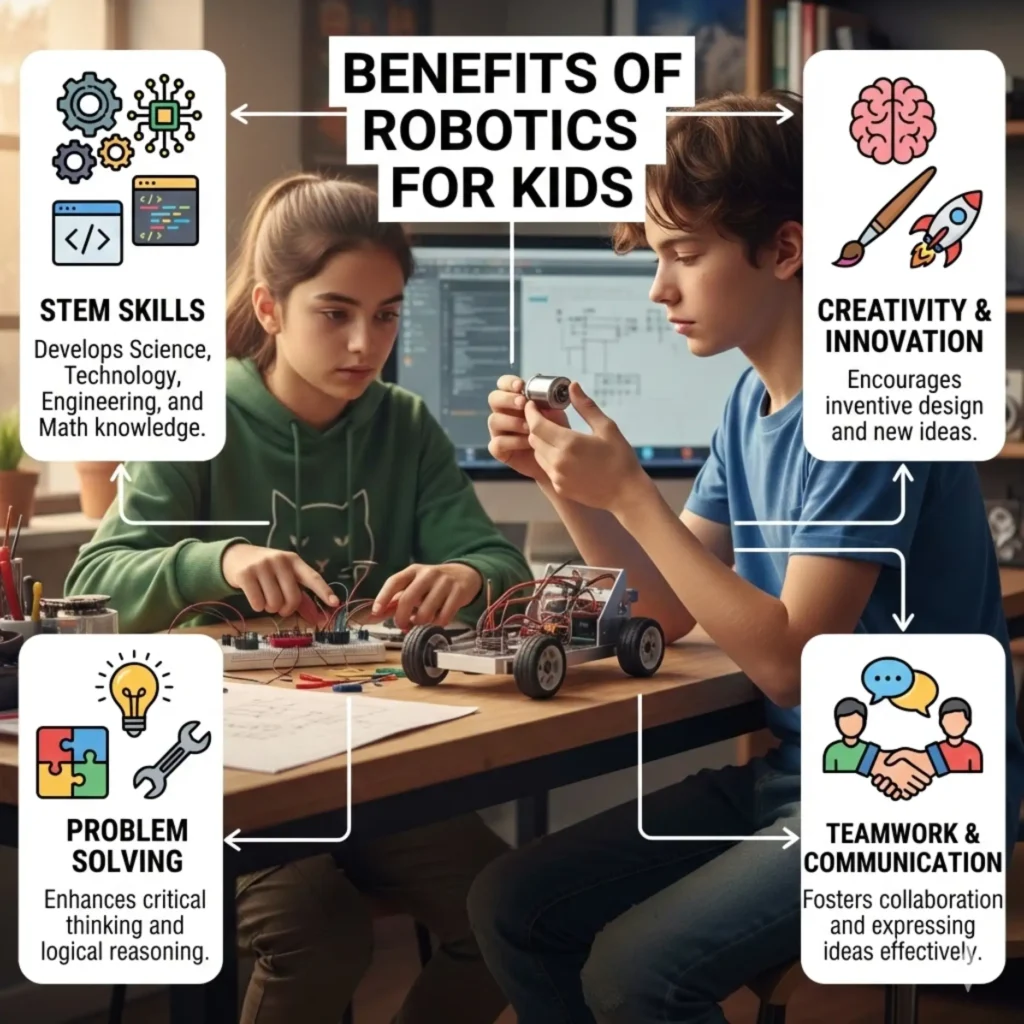
One of the greatest benefits of robotics for kids is that it transforms traditional STEM subjects into practical and engaging experiences. Science, Technology, Engineering, and Mathematics are often taught separately in classrooms. Robotics education brings all these subjects together in a meaningful and exciting way.
Instead of asking, “Why do I need to learn this?”, children begin to see how concepts are applied in real life.
🔬 Turning Theory into Practice
Through hands-on robotics learning, students apply:
- Physics concepts like force, motion, torque, and friction
- Mathematical ideas such as ratios, measurements, and logic
- Engineering principles like gear systems and structural design
- Technology skills including coding and circuit building
When children build a robot that moves, senses, and responds, they are actively using multiple STEM concepts at the same time.
This integration makes learning deeper and more memorable.
🧩 Encouraging Curiosity and Experimentation
Robotics for kids in India encourages experimentation. If a design does not work, students modify it. If the robot moves too slowly, they adjust gear ratios. If the sensor is inaccurate, they recalibrate it.
This cycle of:
- Design
- Test
- Improve
keeps learning dynamic and engaging.
Instead of memorising formulas for exams, children explore how ideas function in real systems. This active approach increases interest in STEM subjects and reduces fear of complex topics.
📚 Bridging the Gap Between Classroom and Real World
Traditional classroom learning sometimes feels disconnected from real-life applications. Robotics education benefits students by bridging this gap. They begin to understand:
- How machines operate in industries
- How automation systems function
- How coding controls physical devices
- How engineering solves everyday problems
This practical exposure makes STEM robotics learning more relevant and purposeful.
🌟 Creating Lifelong Learners
When STEM becomes engaging, children develop curiosity that goes beyond school textbooks. They start asking:
- How does this machine work?
- Can I build something better?
- How can I improve efficiency?
- What happens if I change this design?
This mindset of exploration and innovation is one of the strongest long-term advantages of robotics education.
By making STEM practical, interactive, and enjoyable, robotics helps children develop not only technical skills but also a genuine love for learning.
Frequently Asked Questions (FAQs)
1. Is robotics good for kids in India?
Yes, robotics helps children develop problem-solving skills, logical thinking, coding abilities, and practical STEM knowledge from an early age.
2. At what age can children start learning robotics?
Many robotics programs start from age 6–8 with basic mechanical kits and gradually introduce programming concepts as children grow older.
3. Does robotics education improve academic performance?
Robotics strengthens mathematics, science, and analytical thinking skills, which can positively impact overall academic performance.
4. Is robotics only useful for children who want to become engineers?
No. Robotics builds creativity, teamwork, communication skills, and critical thinking, which are valuable in any career field.
5. Are robotics classes aligned with India’s education goals?
Yes, skill-based and experiential learning approaches in robotics align well with India’s modern education reforms and STEM-focused initiatives.
Understanding the benefits of robotics for kids in India helps parents make informed educational decisions. In a world increasingly shaped by automation, artificial intelligence, and smart technologies, early exposure to robotics gives children a meaningful advantage.
Robotics education is not about turning every child into an engineer. It is about nurturing thinkers, problem-solvers, innovators, and confident learners who are prepared for the challenges of the future.
When children learn to design, build, test, and improve their own creations, they develop resilience, creativity, and independent thinking — skills that remain valuable far beyond the classroom.
Investing in robotics today is not just an extracurricular choice; it is a long-term investment in your child’s curiosity, confidence, and future readiness.
If you are looking for hands-on STEM activities, read our detailed guide on Screen Free Robotics For Kids.
If you would like to understand how STEM robotics education works in detail, you can also explore our complete beginner’s guide here.

Samir Sen is a retired Indian Railways Signalling Engineer with over 30 years of experience in railway signalling systems and safety operations. He also served as a faculty member at a Zonal Signalling Training Institute of Indian Railways, delivering theoretical and practical training in signal engineering. Through SSEN Techno, he simplifies robotics and STEM education for learners and beginners.
Pingback: Robotics STEM Education for Kids: A Simple Parent Guide-2026